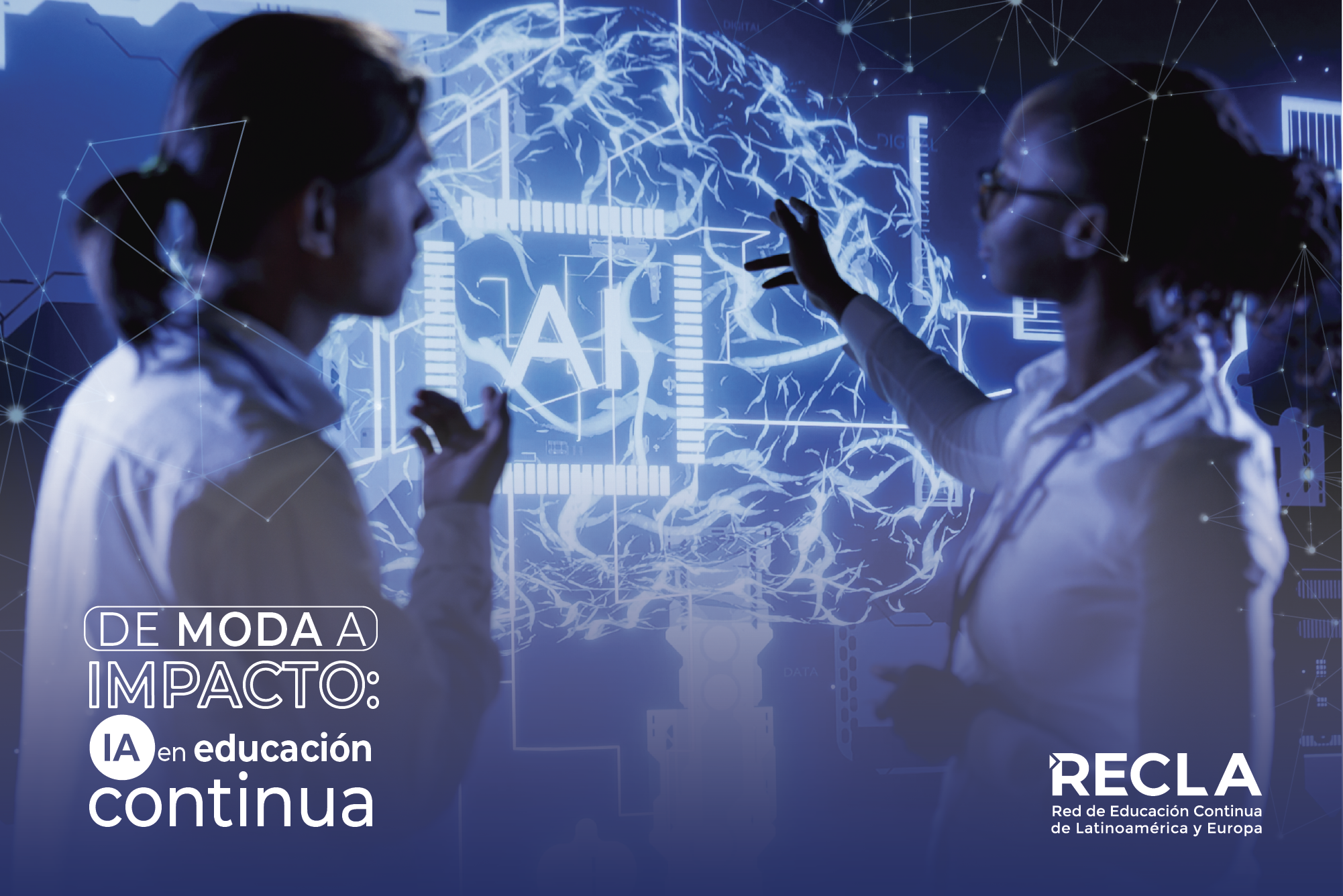

In Latin America, continuing education is undergoing a profound transformation. Every day, more institutions and professionals are asking themselves how to keep pace with technological changes without losing the human element of learning. Amidst this challenge, artificial intelligence (AI) has ceased to be a distant concept and has become a close tool, capable of opening up new ways of teaching, learning, and managing knowledge.
Today, AI is not a passing fad, but an opportunity to reinvent educational processes. However, its true value lies not in the technology itself, but in how we use it and for what purpose. In the realm of continuing education, where students often balance their work and personal responsibilities with their training, AI can become a great support: it facilitates the personalization of content, improves time management, and allows for more efficient guidance.
Even so, enthusiasm must go hand in hand with responsibility. Incorporating artificial intelligence involves making ethical decisions, protecting data privacy, and ensuring that innovation is always at the service of people. This article offers a practical and close look at how to use AI consciously and usefully, so that continuing education not only evolves with technology but also maintains its essence: to help people continue learning throughout their lives.
Talking about artificial intelligence in continuing education today is talking about a change that is already underway. More and more institutions are incorporating it to improve their academic and administrative management, but the challenge is not in using it, but in doing so meaningfully. AI can be a powerful tool if integrated strategically: it can help teachers plan better, personalize materials for different student profiles, and dedicate more time to mentorship than to grading or scoring. Its potential, however, depends on the purpose for which it is used.
The first step is to clearly define what problem we want to solve. It's not about applying technology just because it sounds modern, but about identifying real needs. Perhaps we want to reduce dropout rates, increase class participation, or streamline internal processes. When the use of AI responds to a concrete goal, it stops being a trend and becomes a tool that generates value.
It is also crucial to adapt the curriculum to a digital reality. It is not enough to teach how to use platforms or programs; it is necessary to train in critical thinking, digital ethics, and understanding how algorithms are created and used. Adults seeking continuing education value practical, useful, and applicable content for their work environment. Therefore, programs that integrate real projects or everyday cases tend to generate more commitment and meaningful learning.
For educators, artificial intelligence can be an educational co-pilot. There are tools that help draft rubrics, suggest examples, or create exercises adapted to the level of each group. This does not replace the teacher, but it does allow them to focus on the most important part of the process: guiding, listening, and accompanying with empathy. Instead of replacing human work, AI can make it more efficient and more human at the same time.
From the student's perspective, the benefits are also evident. Intelligent systems can offer personalized learning paths, suggest supplementary resources, or answer questions immediately through virtual assistants.
However, none of this makes sense if personal data protection and human supervision are not guaranteed. The balance between automation and support is what ensures a truly valuable educational experience.
And, of course, every advance must be measured. It's not enough to implement AI; you need to evaluate if it truly improves the quality of the results. Metrics such as completion rates, participant satisfaction, or impact on their job performance can help identify how effective its application is.
In the realm of marketing and merchandising, artificial intelligence is also transforming the way communication strategies are planned, executed, and analyzed. Today, brands, universities, and continuing education units are using tools that process large volumes of data to better understand their audiences. AI makes it possible to anticipate interests, segment audiences, and send more precise and personalized messages.
Thanks to predictive analysis, it's possible to identify what types of content generate the most interaction, which topics spark the most curiosity, or which profiles are most likely to enroll in a course. This way, campaigns stop being mass-market and become more human and direct actions. Marketing teams also save time: platforms automate tasks like ad management, email sending, or database updates, allowing people to focus on what truly matters—creativity, strategy, and building relationships with students.
Ultimately, artificial intelligence has changed the way we understand educational communication. It's no longer just about attracting participants, but about understanding them deeply and offering them experiences that feel relevant and relatable. When that empathetic perspective is applied to the design of academic programs, AI ceases to be a technological tool and becomes a strategic ally for continuous learning.
Artificial intelligence is already part of our professional and educational lives, but its true impact depends on how we decide to use it. Technology, by itself, changes nothing; it is people who give meaning to its use. When AI is integrated with purpose, empathy, and vision, it can become a powerful ally in strengthening continuing education and making it more accessible, flexible, and human.
Incorporating it into training programs doesn't mean replacing the closeness of a teacher or interaction with students, but rather enhancing those relationships. AI can help us listen better, personalize teaching, and offer constant support. In the area of educational marketing, it also opens up the possibility of designing smarter strategies that can connect with the true needs of participants and the values of each institution.
Today, Latin America has the opportunity to lead an educational transformation that combines technological innovation with social sensitivity. This is not about chasing digital fads, but about using artificial intelligence with judgment, purpose, and heart. If we do it right, we can build learning experiences that not only train professionals but also individuals who are more aware and prepared for the challenges of the future.
From RECLA, we continue to promote spaces for sharing good practices in the ethical use of AI in continuing education.
Author: Nelly Paola Armas Castañeda