

Practical guide for RECLA members and external speakers
Main idea
A best practices session is not about giving a closed lecture. It's about turning a specific experience into useful learning for others.
Intended use of the document
This document offers a common guide for preparing short sessions to share best and worst practices, as well as significant experiences, for EC units or the universities belonging to the Network. The guide helps to structure the presentation, select what might be interesting to share, and formulate a final discussion focused on learning transfer.
It is important to remember that the purpose of these sessions is to generate learning, foster collaborative reflection, build networks among institutions, and strengthen RECLA itself. The recommended duration of the entire session is 50 minutes: 30 minutes to present the experience and 20 minutes to open a final dialogue with the participants.
General structure of the session
The session is organized into two complementary parts. The first part focuses on presenting the experience and should form the core of the presentation. The speaker presents a real case, explains the decisions that shaped the process, shows the available evidence, and draws lessons that may be useful for other RECLA members. The second part opens a space for dialogue, allowing participants to discuss the experience, compare and contrast it, enrich it, and explore its potential transfer to other contexts.
Table 1. Structure of the session for sharing experiences
| Part | Duration | Purpose |
|---|---|---|
| Presentation of the experience | 30 min | Present a real-life experience, explain your decisions, show evidence, and conclude with transferable learnings. |
| Final dialogue | 20 min | Open up contrasting and transferable questions that generate an enriching debate. |
Source: Own elaboration
This format allows for a proper balance between presentation and discussion. The initial presentation should provide a sufficiently clear foundation for the subsequent dialogue to make sense. The final discussion should help formulate questions, identify nuances, and assess possibilities for adaptation. The priority is that each shared experience yields the most concrete, understandable, and transferable learning possible for the RECLA community.
1. Purpose of the sessions
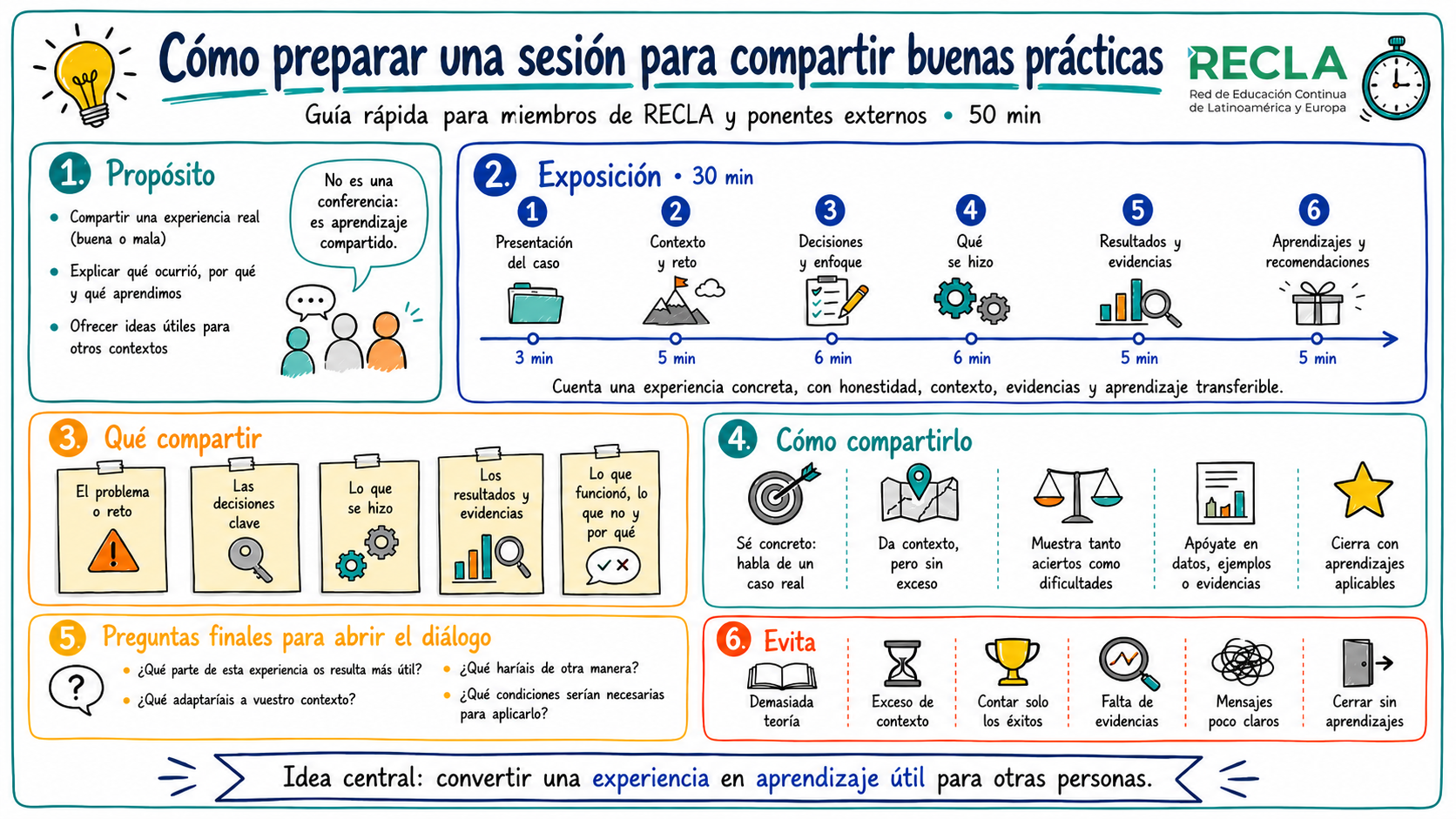
The session should share a real experience, whether it yielded positive results or fell short of initial expectations, so that others can understand what happened, why a certain course of action was taken, and what lessons can be applied to other contexts. It is not about demonstrating how well a university or organization does something, but about sharing lessons learned that enable its continuous improvement.
• The experience should be concrete and situated in a recognizable context.
• The presentation should explain decisions, actions, results, and lessons learned, not just describe
activities.
actividades.
• The presenter should present the experience honestly, including successes, difficulties,
limitations, and evidence.
Quality criteria
The participant should leave the session with a clear idea of what they could adapt, what they should avoid, and what conditions they would need to consider in their own context.
2. Presentation of the experience: 30 minutes
The presentation forms the core of the session before the discussion. The presenter should use the 30 minutes to narrate a specific experience in an organized, understandable, and transferable manner.
To facilitate session preparation, it is suggested that the initial presentation be structured into six brief sections. This organization helps the presenter move beyond simply recounting an experience chronologically and instead transform it into a learning narrative: what happened, in what context, what decisions were made, what actions were taken, what results were obtained, and what lessons learned might be useful to others. The time allocation is a guideline, but it helps maintain focus and ensures that the session dedicates sufficient attention to both the experience itself and its potential application to other contexts.
Table 2. Indicative outline for the session
| Block | Approximate time | What should the speaker explain? |
|---|---|---|
| 1. Case presentation | 3 min | Que experiência você compartilhará, por que ela é relevante e qual o principal aprendizado que você prevê? |
| 2. Context and challenge | 5 min | Where did the experience take place, what need or problem caused it, and who participated? |
| 3. Decisions and approach | 6 min | What decisions were key, what alternatives were considered, and what criteria guided the actions? |
| 4. What was done | 6 min | What actions were taken, in what sequence, and what adjustments were made during the process. |
| 5. Results and evidence | 5 min | What results were obtained, what evidence supports them, and what limitations should be taken into account? |
| 6. Lessons learned and recommendations | 5 min | What worked, what didn't work, what would be done differently, and what recommendations might be helpful. |
Source: Own elaboration
This sequence allows the presentation to progress from describing the experience to interpreting and leveraging it. The presenter should avoid presenting the practice as a rigid formula or an unquestionable success story. Their contribution will be more valuable if they clearly explain the criteria that guided the action, the difficulties encountered, the adjustments made, and the lessons learned. In this way, participants can identify which elements could inspire their own practice, what conditions would be necessary to adapt them, and what precautions should be taken before implementing them.
3. What to share
The presenter should carefully select the information to be shared and avoid an overly long narrative. The practice should be understandable to people who may not necessarily be familiar with the original context; therefore, it is advisable not to spend too much time explaining the university or the Continuing Education unit itself, unless that information is essential to understanding the case. The important thing is to focus the presentation on the specific experience and show the relationship between the initial challenge, the decisions made, the actions taken, the available evidence, and the lessons learned. The following table proposes five elements that help prepare the session from a learning perspective, and not just a descriptive one, so that the experience is presented clearly and usefully for other contexts.
Table 3. Session Preparation
| Element | Function within the session | Preparation questions |
|---|---|---|
| The problem or challenge | It allows us to understand the reason for the experience. | What need, problem, or opportunity gave rise to the practice? Why was it important to act? |
| The key decisions | It shows the logic behind the actions and allows learning from the criteria used. | What decisions shaped the process? What alternatives were discarded and why? What was the underlying logic? |
| What was done | It allows you to reconstruct the process without getting lost in irrelevant details. | What actions were truly decisive? What sequence did the experience follow? |
| The results and evidence | It adds rigor and prevents the session from being based solely on impressions. | What data, examples, testimonies, or signs allow us to assess the result? |
| What worked, what didn't, and why | Transform the experience into transferable learning. | What would we repeat? What would we change? What conditions explain the result? |
Source: Own elaboration
These five elements allow for the construction of a clear narrative of the experience and, at the same time, facilitate its transferability. The presenter should avoid a superficial description of what was done or a general assessment such as "it worked well." Their contribution will be more valuable if they show what problem justified the practice, what criteria guided the decisions, what actions were truly relevant, what evidence allows for evaluating the results, and what conditions explain both the successes and the difficulties. In this way, the experience is not presented as a rigid formula, but as a case study from which lessons, questions, and action criteria can be drawn for other contexts.
4. How to share the experience
The quality of the session depends as much on how the presenter constructs the narrative as on the listening, interaction, and support of the other participants. A well-told experience is not a succession of events, but a reasoned explanation of a learning process. Therefore, the presenter should feel comfortable, enjoy sharing their experience, and perceive that they are in a trusting environment where everyone participates with a willingness to learn and contribute. At the same time, the presentation should avoid being overly general, excessively institutional, or focused solely on positive results. A good session should help participants understand the case, identify its key elements, and assess which aspects might be useful in other contexts. The following table offers some practical recommendations for preparing a clear, concise, and learning-oriented presentation.
Table 4. Recommendations for presenting the experience
| Recommendation | Practical application |
|---|---|
| Be specific | Choose a real and specific case. Avoid a generic presentation about the institution, program, or work area. |
| Provide context without overdoing it. | Provide only the information necessary to understand the case. The context should be helpful, not the focus of the session. |
| Show successes and difficulties | Explain both what worked and what generated resistance, error, tension, or unexpected learning. |
| Rely on evidence | Where possible, incorporate verifiable data, examples, indicators, testimonials, observations, or results when available. |
| Conclude with applicable lessons learned | End with ideas that can be interpreted and adapted by other people, without presenting them as universal recipes. |
Source: Own elaboration
These recommendations help present the experience as a learning case study, not simply as an activity demonstration. The presenter should provide enough information to make the case understandable, but should always keep the focus on what allows for learning: the challenge addressed, the decisions made, the actions taken, the available evidence, and the lessons learned. In this way, the session is not presented as a demonstration of success, but as an opportunity to share practical knowledge, compare perspectives, and enable others to adapt the experience to their own situations.
5. Final questions to open the dialogue
The final dialogue should not be secondary to the experience presented. Its function is to facilitate the transfer of learning, not to replace the presentation or generate a scattered discussion, but to learn through dialogue. To this end, this part can begin by inviting participants to answer one or two of the following questions:
• What part of this experience do you find most useful?
• What would you adapt to your context?
• What would you do differently?
• What conditions would be necessary to apply it?
The presenter can select two questions and use them to close the session. It is not necessary to answer all the questions; simply stimulate a conversation focused on application.
6. Mistakes to avoid
A best practices session can lose its impact when the presenter strays from the specific experience, spends too much time on context, or presents the case as a simplistic success story. These mistakes not only affect the clarity of the presentation but also reduce the potential for shared learning. Therefore, it's advisable to anticipate some common pitfalls and prepare the presentation so that the case is presented with concreteness, balance, and a practical focus. The following table identifies the most frequent errors, explains why they can weaken the session, and suggests a simple way to correct them.
Table 5. Errors to avoid in the presentation
| Mistake | Why does it weaken the session? | How to fix it |
|---|---|---|
| Too much theory | It distances the session from real-life experience and reduces its practical usefulness. | Use theory only if it helps to interpret the case. |
| Excessive context | It consumes time and shifts attention from the experience to the institutional description. | Select only the essential context data. |
| Count only the successes | It reduces credibility and limits learning. | Incorporate difficulties, errors, limitations, and adjustments. |
| Lack of evidence | It turns experience into an opinion that is difficult to verify. | Provide data, examples, signs, or testimonies. |
| Unclear messages | It makes it difficult for participants to remember the main idea. | Close each section with a summary sentence. |
| Closing without learning | The session remains as a story, but not as a source of learning. | Formulate 3 final lessons learned or recommendations. |
Source: Own elaboration
These errors should not be seen as formal flaws, but rather as aspects that can limit the experience's capacity to generate learning. The presenter should remember that the value of the session lies not in presenting a perfect practice, but in offering a comprehensible, honest, and useful experience. A well-focused presentation selects relevant information, provides evidence when available, acknowledges the limitations of the case, and concludes with clear takeaways. In this way, participants can better understand the experience, discuss it, and assess which elements might be relevant in their own contexts.
7. Brief template for preparing the intervention
The presenter can prepare the session by answering a series of basic questions beforehand. This template allows for easy organization of the experience and transforms a specific case into a clear, useful, and learning-oriented session. The goal is not to create a complex presentation, but rather to identify the essential elements beforehand: the challenge that gave rise to the practice, the minimum context necessary to understand it, the decisions that shaped the process, the actions taken, the available evidence, and the lessons learned that can be shared with other RECLA members.
Table 6. Brief template for preparing the intervention
| Aspect | Preparation question |
|---|---|
| Title of the experience | What is the name of the practice or experience that will be shared? |
| Problem or challenge | What specific need gave rise to the experience? |
| Minimal context | What information does the group need to know to understand the case? |
| Key decisions | What decisions explain the development of the experience? |
| Actions taken | What was actually done and in what sequence? |
| Evidence | What data, examples, or signs allow us to assess the result? |
| Learning | What worked, what didn't work, and what would be done differently? |
| Transfer | What might be useful for other RECLA members? |
Source: Own elaboration
This template can be used as a pre-session preparation tool. The presenter can briefly answer each question and, based on those answers, build the script for their presentation. The goal is not to complete all sections with the same level of detail, but rather to ensure that the experience is presented in a clear, balanced, and transferable way. The result should be a presentation that not only describes what was done, but also helps to understand why it was done, what was learned, and what elements could inspire new practices in other continuing education contexts.
8. Final checklist before the session
One way to assess whether the experience to be shared aligns with the purpose of these sessions is to use the following checklist. It is not intended as a closed or definitive checklist, but rather as a support tool to improve the quality of the session and foster mutual learning from the shared experience.
☐ I have chosen a specific experience, not a general topic.
☐ I have reduced the context to the essentials for understanding the case.
☐ I have identified the decisions that explain the practice.
☐ I have selected relevant evidence, data, examples, or testimonials.
☐ I have included both successes and challenges.
☐ I have prepared three applicable final lessons learned.
☐ I have chosen one or two questions to open the final dialogue.
☐ I have prepared the session as a learning conversation, not as a defense of results.
Final message
The goal of the session is not to demonstrate that a practice was perfect, but to show how a real experience can be transformed into shared, useful and transferable knowledge for other people.
Learning isn't limited to those who listen. A good follow-up dialogue allows participants to interpret the experience from their own perspectives, but it also helps the person sharing it to review, refine, and improve their own approach. In this sense, the session should be understood as a space for mutual learning: the presenter organizes and compares their experience; the participants analyze it, question it, and connect it to new possibilities for application.

Author: José Luis Alonso Andreano
Professor, researcher and facilitator
Mondragon Unibertsitatea and MIK







Me parece muy interesante esta Guía ya que indica las directrices a seguir para poder compartir una experiencia que haya sido de gran impacto en los objetivos relacionados con las tres funciones sustantivas que tiene la institución tales como: Académia, Investigación y Vinculación.