
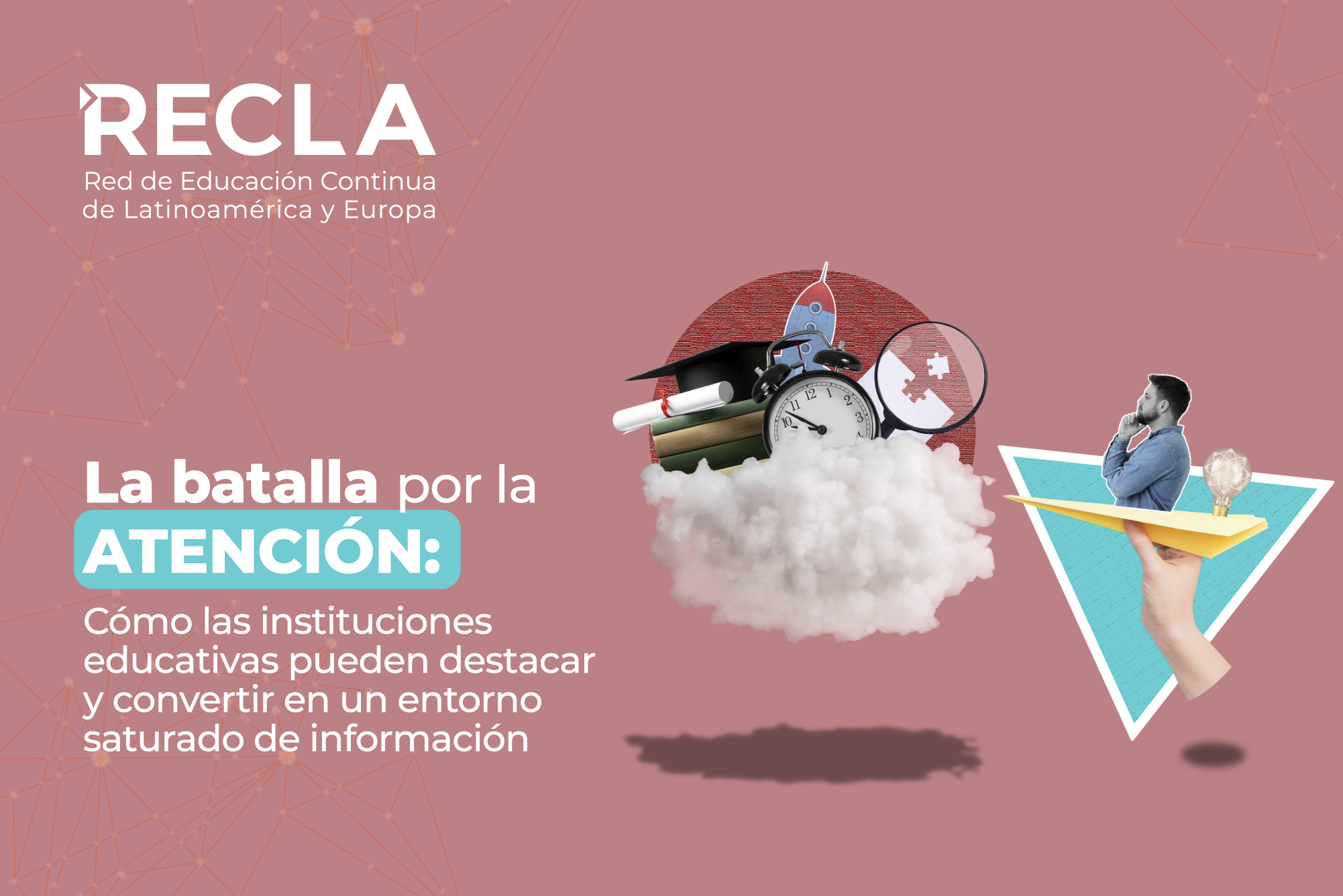

We live in an era where attention has become one of the most valuable and hardest-to-obtain resources. Every day, people are bombarded with thousands of stimuli through social media, websites, apps, emails, and digital platforms. Amid this reality, higher education institutions face an increasingly complex challenge: ensuring their academic offerings are not only seen, but also considered and chosen.
From my experience in digital media and continuing education, I've observed that many institutions make significant communication and promotional efforts, but they don't always manage to translate that visibility into concrete results. Having reach is no longer enough. The real goal is to capture the right attention, generate genuine interest, and guide prospective students until they become enrolled.
The Attention Economy and Its Impact on Education
Today's competition is not limited to other universities or training centers. Educational institutions compete for attention with content creators, entertainment platforms, commercial brands, and a virtually endless amount of information available online.
In this context, capturing attention requires a deeper understanding of target audiences. Prospective students seek relevant experiences, clear information, and value propositions that address their personal and professional needs. Generic messages are increasingly less effective than more personal, authentic content that focuses on resolving real concerns.
Capturing is not the same as connecting
One of the most common mistakes in educational promotion strategies is assuming that high exposure guarantees results. A campaign can reach thousands of people and still generate few enrollments.
Effective engagement occurs when content resonates with the audience's motivations. To achieve this, it's essential to communicate concrete benefits, showcase real-life stories, demonstrate results, and highlight what sets the institution apart from other options.
Rather than selling academic programs, institutions should communicate opportunities for growth, professional development, and personal transformation.
Conversion: Where the strategy proves its effectiveness
Once interest has been sparked, an equally important stage begins: conversion.
The prospect's experience during the consultation and enrollment process can determine the success or failure of a marketing strategy. Complex forms, long response times, or unclear information often become barriers that significantly reduce the chances of enrollment.
Conversely, agile, personalized attention focused on solving needs generates trust and facilitates decision-making.
In an environment where users expect immediate answers, the speed and quality of business follow-up have become differentiating factors.
The role of data in decision-making
Educational institutions today have an advantage that was difficult to imagine a few years ago: the ability to measure virtually every interaction of their audiences.
Analyzing indicators such as cost per lead, conversion rates, browsing behavior, and the channels that generate the best results allows for optimizing resources and continuously improving acquisition strategies.
Data-driven decisions offer a more accurate view of prospective students' behavior and facilitate the creation of more effective experiences.
These principles have been put into practice by UGB Plus Continuing Education, at Gerardo Barrios University, in San Miguel, El Salvador. A recent example was the organization of the International Workshop "Business Continuity, Legal Protection, Strategic Succession, and Conflict Management in Family Businesses ,"an initiative aimed at entrepreneurs, owners of family businesses, and representatives of the productive sector.
Rather than simply promoting an event, the strategy focused on communicating a value proposition aligned with the real needs of the target audience. The campaign highlighted the relevance of the topic, the international experience of the Argentine speaker—with whom a specialized program in international law had previously been developed—and the opportunity to create spaces for professional development, networking, and practical learning.
The results confirmed the importance of understanding the audience before communicating .The workshop brought together more than 70 attendees from various companies and institutions across the country and was supported by three sponsoring companies, demonstrating that a strategy based on relevant content, appropriate segmentation, and strategic alliances can generate a high response from the public.
The main lesson was that people don't respond solely to product or service promotions, but rather to solutions that address specific problems and build trust. When communication provides value from the very first contact, attention ceases to be an isolated objective and becomes the beginning of a lasting relationship with the audience.
Author: Pedro Canizales







Mil gracias por este análisis tan acertado. Demostrar que captar la atención exige conectar con las motivaciones profundas del estudiante transforma por completo la estrategia educativa.